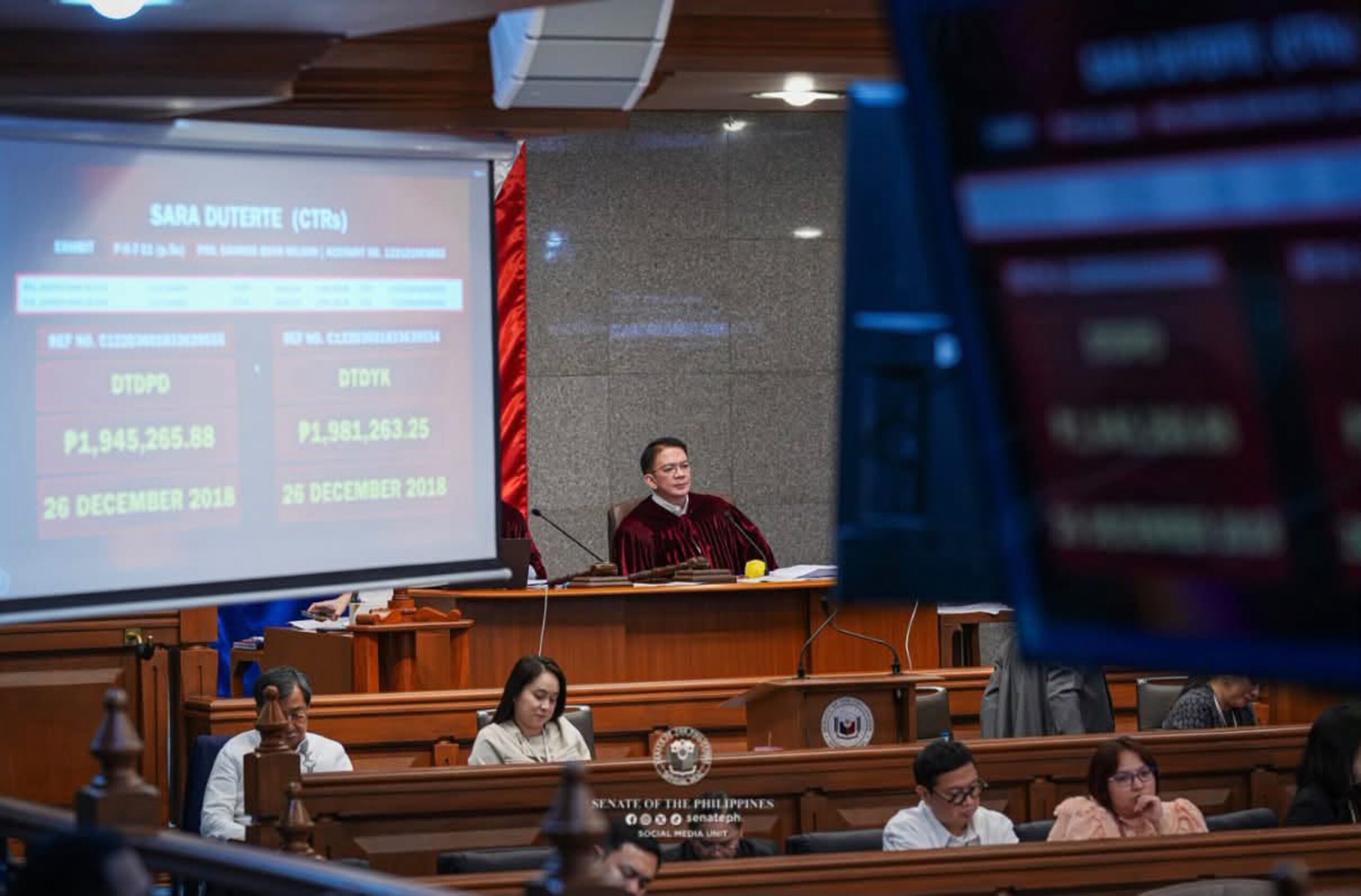
The Senate impeachment court has admitted most of the documentary evidence the House prosecution panel offered against Vice President Sara Duterte, rejecting defense objections to how the records were obtained and whether they belonged in the case, Rappler reported.
In a ruling dated Thursday, November 5, the court said it was setting aside the defense's continuing objection, which argued that the exhibits had not been attached to the impeachment complaint and had been gathered through subpoenas issued during the trial. The decision was reported by Rappler, with Inquirer.net, the Philippine News Agency and ABS-CBN also covering the day's developments.
The ruling leaves Article 2, which centers on allegations of unexplained wealth, as the only impeachment article still before the court. The House prosecution panel previously withdrew the three other articles.
Why it matters
The ruling clears the way for the senator-judges to weigh a large body of financial records against the Vice President, and it formally closes the prosecution's presentation of evidence on the sole remaining charge. It also draws a firm line around what those records may be used to prove: the court said older documents can serve only as a starting point for assessing Duterte's finances while in office, not as the basis for new charges.
At the same time, the court paired its admission of evidence with a reminder that acceptance is not the same as proof. According to the ruling, admitting an exhibit does not by itself establish that its contents are true or accurate, and the weight and sufficiency of each item are left to the senator-judges to decide in their final deliberations.
A baseline, not a separate charge
The court allowed Duterte's records from 2007 to 2021 into the case but restricted their purpose. They may be used only to establish a factual baseline against which her assets, liabilities, net worth, financial resources, transactions and business interests from 2022 to 2025 can be evaluated under Article 2, the ruling said.
The court was explicit about the limits. Pre-incumbency records cannot be used to charge or establish a separate impeachable offense committed before Duterte became Vice President, cannot support liability for conduct outside Article 2, and cannot revive any of the withdrawn articles. The ruling also said no pre-incumbency record may be admitted merely to suggest a habit or propensity to break the law, since such a propensity is irrelevant to the article at issue.
What was admitted and what was excluded
Among the admitted materials were Duterte's Statements of Assets, Liabilities, and Net Worth, along with bank and insurance records and documents from the Bureau of Internal Revenue, the Securities and Exchange Commission, the Philippine Government Electronic Procurement System and the Land Registration Authority.
Records from the Anti-Money Laundering Council were also admitted. The court said these could establish that reports — including intelligence reports, covered transaction reports and suspicious transaction reports — were filed with or issued to Duterte, and could show the transaction flows reflected in them to the extent they bear on Article 2. Bank and tax records were admitted to show reported income, assets and business interests, while insurance and investment records were admitted for policy, investment, ownership, payment and account details that may be compared with the SALNs and other financial records.
The court excluded corporate records of the JTC Group of Companies Philippines Incorporated and Pikimong Pikimong Philippines Corporation, including entries, summaries, schedules and computations drawn from those records in other exhibits. It also excluded part of the forensic financial report of lawyer Alex Cabrera dealing with the two companies, while admitting the rest of his analysis. The validity of the report's assumptions, methodology, totals and inferences still awaits the senator-judges' final assessment, the court said.
Separately, the court did not admit Commission on Audit findings and notices of disallowance on confidential fund disbursements by the Office of the Vice President and the Department of Education in 2022 and 2023, because they had been offered in connection with Article 1, one of the withdrawn articles. Inquirer.net reported that the court turned down the bid to admit the COA documents as proof of unexplained wealth.
With the prosecution's formal offer of evidence resolved, the court said the prosecution had formally rested its case-in-chief on Article 2.
Gag rule restored
In a separate decision, the court reinstated Rule 18 of the Rules of Procedure on Impeachment Trial across all the articles against Duterte, including those withdrawn or still awaiting adjudication, the Philippine News Agency reported. The step followed a defense objection to dropping the sub judice restriction on the withdrawn articles.
The sub judice rule bars public comment on the trial while it is ongoing.
Presiding Officer Chiz Escudero has been overseeing the proceedings, which reached their 33rd day on October 5, 2026, according to Rappler.
The trial resumes on November 9, when the defense team is scheduled to present its evidence.